The firewall: CSF and LFD#
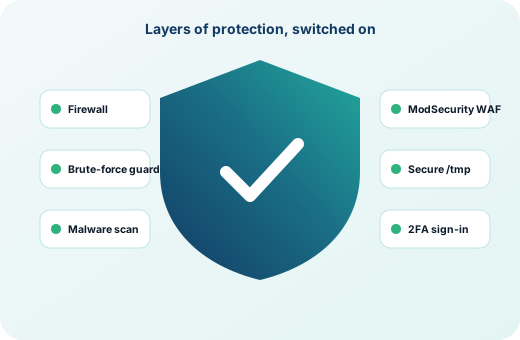
The installer sets up CSF as the server's firewall and LFD as its login protection, tuned for shared hosting: IPv6 filtered as well as IPv4, large block lists kept in fast ipset tables, connection limits per address on mail, FTP, SSH and web ports, port-scan detection, limits on outgoing UDP floods, outgoing mail on port 25 only from the mail server, and fork bombs ended. Manage it under Security → Firewall & Settings: allow and block lists, temporary blocks, open ports, every CSF option with its note, and the logs. Find an address shows every rule that mentions an address, with a button to unblock it.
Sign-in attack protection#
Failed sign-ins to the panel lock the address out for a while. Through LFD the same protection covers SSH, FTP, sending mail, POP3 and IMAP, with a limit per service and a block time you choose. Country blocking works for every service at once.
ModSecurity#
ModSecurity checks every request to the websites against the OWASP Core Rule Set before it reaches PHP. Choose its mode, see which requests matched a rule in the ModSecurity Hit Log, and switch it off for a single website that needs it.
Malware scanning#
Under Add-ons → Malware Scanners install ClamAV, Linux Malware Detect (Maldet), or both. Schedule scans in batches, move what is found to quarantine, try cleaning injected code, or suspend accounts with hits automatically. Clients can scan their own files from the client area.
Hardening that is on by default#
- A protected
/tmpthat cannot run programs. - Symbolic link protection and home-folder URLs off.
- Compilers closed to users, shell processes limited.
- Cron jobs checked for download-and-run malware.
- Two-factor sign-in for every login, with recovery codes.
- Free SSL certificates for every domain with Automatic SSL, and DNSSEC.
The Security Checkup page lists what could still be made safer, most important first, with a link to each setting.
Frequently asked questions
Can I use my own CSF settings?
Yes. Every CSF option is on the Settings tab, and advanced rules written by hand in csf.allow, csf.deny or csf.ignore are kept. Reinstalling the panel does not change your values back.
Is ClamAV installed by default?
No. ClamAV needs about 3 GB of memory, so the scanners are installed from the panel when you want them. Maldet works on smaller servers with its own lighter engine.
Does intoPanel support two-factor authentication?
Yes, for administrators, resellers and clients, with authenticator apps and recovery codes.